Cyber Attacks Through Optimizely Hit HSBC Sites in the Philippines, Malaysia, Singapore and Vietnam
Cyber attacks through Optimizely on 16 November served a card skimmer and iPhone exploits to visitors of 178 organisations, HSBC sites in four ASEAN countries among them.
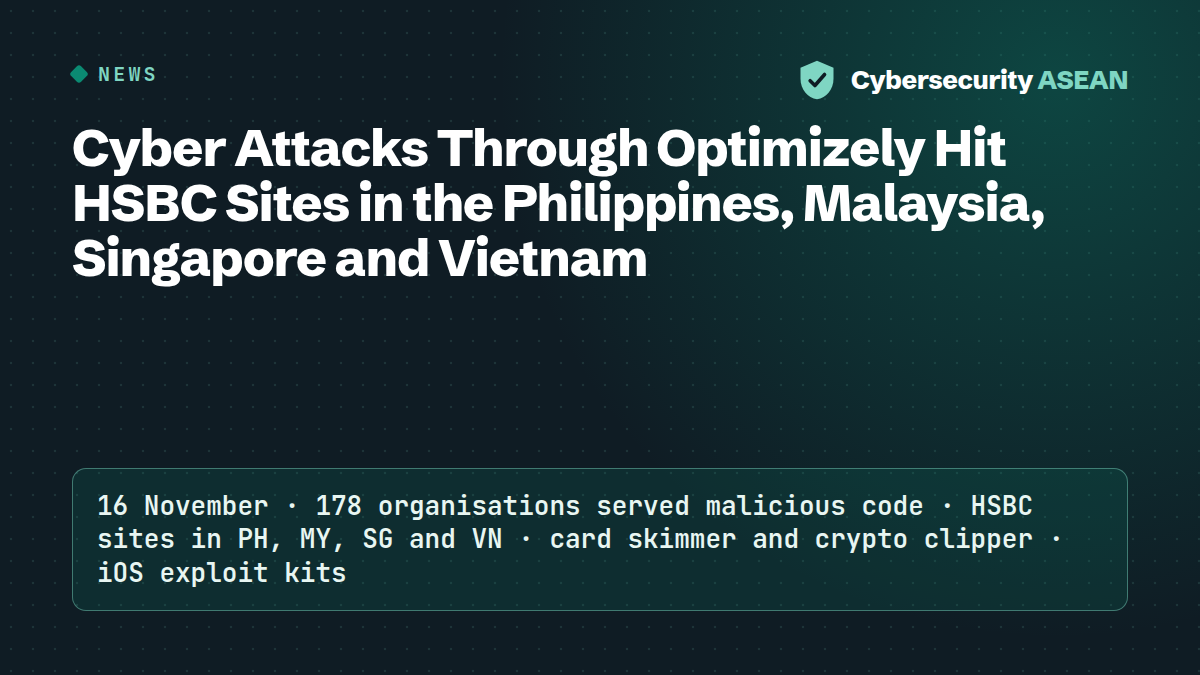
On 16 November an attacker planted malicious JavaScript in Optimizely's Web Experimentation scripts, and it ran for visitors of 178 organisations, according to Scott Helme of Report URI, who found it. His list of affected domains includes HSBC's sites in the Philippines, Malaysia, Singapore and Vietnam: www.hsbc.com.ph, www.hsbc.com.my, www.hsbcamanah.com.my, www.insurance.hsbc.com.sg and www.hsbc.com.vn. Optimizely says "an unauthorized party exploited a vulnerability" and that the injected code has been removed.
Other sites in the region
Levi's shops in Malaysia, Singapore, Indonesia and the Philippines and Crocs India also appear on the list. Elsewhere, AFP named Zoom, the BBC, CNN, IKEA, Equifax and Air France-KLM among the victims. Banks and financial firms were the largest group, with 32 organisations.
What the code did
Helme's timeline starts with the first injection at 04:21 UTC; a card skimmer was added at 13:43 and most sites were cleaned between about 20:40 and 21:10. The payload swapped copied crypto wallet addresses for the attacker's, which brought in about $7,150. It also took cookies, page screenshots, and card numbers, expiry dates and CVVs typed into a site's own forms, though cards entered in hosted payment iframes such as Stripe or Adyen were out of its reach.
iPhone and iPad visitors were sent exploit kits: Coruna for iOS 13 to 17 and DarkSword for iOS 18. The kit's own comments treat iOS 18.7.3 and later, and 26.3 and later, as patched.
Few security policies stopped it
Of the hosts Report URI crawled, 68 had no Content Security Policy and only 24 blocked the payload. On an HSBC site the policy blocked the external file, but "the inline copy still ran" because it permitted 'unsafe-eval'. How the attacker got in is still open: Helme writes that "we don't know how the attacker got write access to so many unrelated customer projects".
Optimizely's response
The company told AFP it had "identified and contained a security incident" and that customers have been contacted directly. It has also taken steps to secure affected user accounts, its status update says.
More news
Apple iMessage Phishing Scams Singapore: At Least S$31,000 Lost to Fake Courier and Polyclinic Messages
Apple iMessage phishing scams Singapore police warned of on 14 November have cost victims at least S$31,000 since 31 October, posing as couriers and SingHealth polyclinics.
Malaysia Health Ministry Cyber Breach: File-Sharing Platform at One Facility Accessed, Main Systems Unaffected
Malaysia's Health Ministry says someone got into a file storage and sharing platform at one of its facilities on 12 November; main systems and patient services were not affected.
Singapore Cyber Incidents Triple Since September, CSA Says; PDPC Sees No Clear Link Between Breaches
Singapore cyber incidents reported since September run at three times the January–August monthly rate, CSA says; PDPC sees opportunistic attacks with no clear connection.