Cyberattack Claims Hit 23 Philippine Institutions; DILG Checks a Possible Barangay Data Breach
Cyberattack claims now name 23 Philippine institutions, a monitoring group says. The DILG is checking a possible breach of its barangay records system; the AFP says nothing is verified.
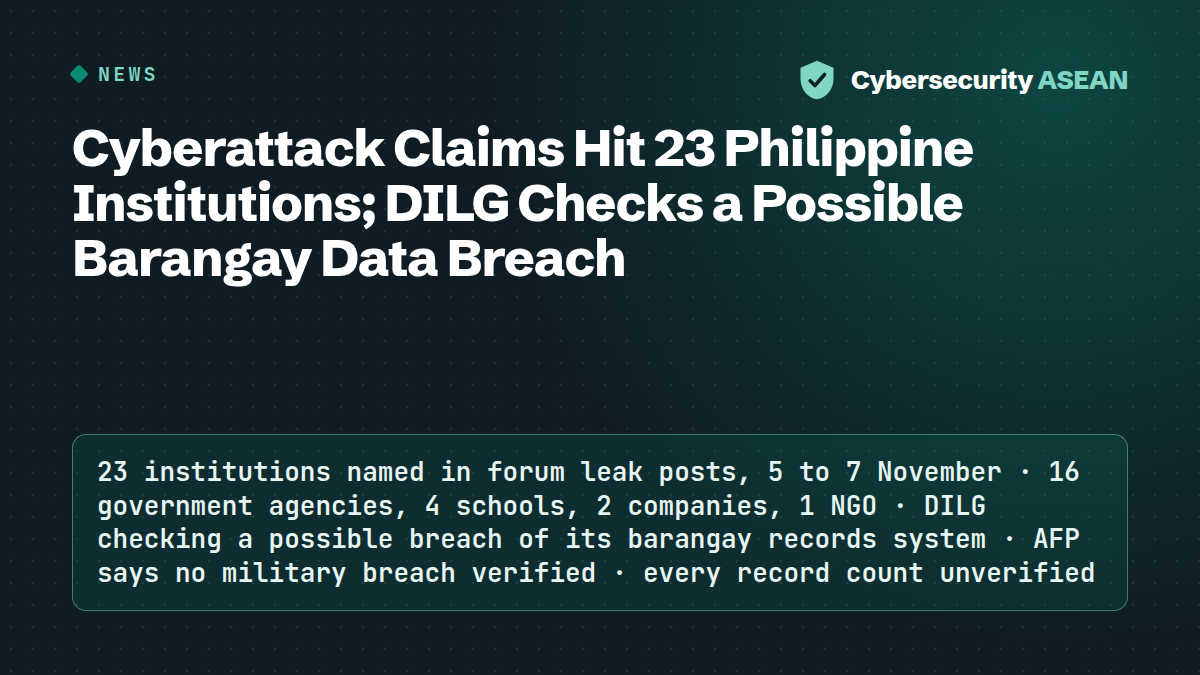
Cyberattack claims posted on hacker forums between 5 and 7 November name 23 Philippine institutions: 16 government agencies, four schools, two companies and one NGO, according to a tally by the monitoring group Deep Web Konek that Radar.ph and The Philippine Star reported. On 10 November the Department of the Interior and Local Government (DILG) said it was verifying a possible data breach in its barangay records system.
Ten agencies, the Bureau of Internal Revenue (BIR) and the Securities and Exchange Commission among them, have filed breach notifications with the National Privacy Commission, which hasn't said whether the incidents are connected.
What the posts claim
Radar counts 18 of the 23 incidents flagged on 5 November. According to the Star, a group called DeathNote Hackers posted about 10GB of Office of the Vice President files and 19.2 million labour department records, while Happy Go Lucky PH says it holds up to 19 million resident profiles from the DILG and the Barangay Central Database. Unbox.ph, which puts the combined total at over 600GB, stresses that none of these numbers is confirmed.
The DILG barangay system
The DILG says it received a report of a possible breach in LGUSS-BIMS, the system that holds the Records of Barangay Inhabitants. It has contacted the National Privacy Commission but hasn't said whether any data left the system.
The military's position
AFP spokesperson Col. Francel Margareth Padilla said Cyber Command and the service cyber units are checking whether the claims are credible: "We still have to conduct a proper forensic investigation". The Air Force says there is "nothing verified" so far.
What residents are told
The privacy commission's advice is to expect phishing, fraudulent messages and identity theft attempts, and to avoid suspicious links and attachments.
More news
Election Commission Malaysia Website Cyberattack: EC Works With MCMC as Melaka Early Voting Opens
Election Commission Malaysia says its website faced a suspected cyberattack on 10 November, as Melaka's early voting opened. It is working with MCMC and hasn't said what was hit.
Microsoft November 2026 Patch Tuesday: Exploited Outlook Flaw Leaks NTLM Hashes, 64 Critical Fixes
Microsoft's November 2026 Patch Tuesday fixes an exploited Outlook flaw that leaks NTLMv2 hashes, plus 64 critical bugs, among them a Windows Search flaw reachable through Exchange.
GPUStack CVE-2026-102895 Exploited: Forged Loopback Requests Hand Attackers Admin and Reverse Shells
GPUStack CVE-2026-102895 lets a forged header or a same-host proxy pass as the built-in admin. Attackers used it to run reverse shells; CISA lists it as exploited. Fixed in 2.2.0.